









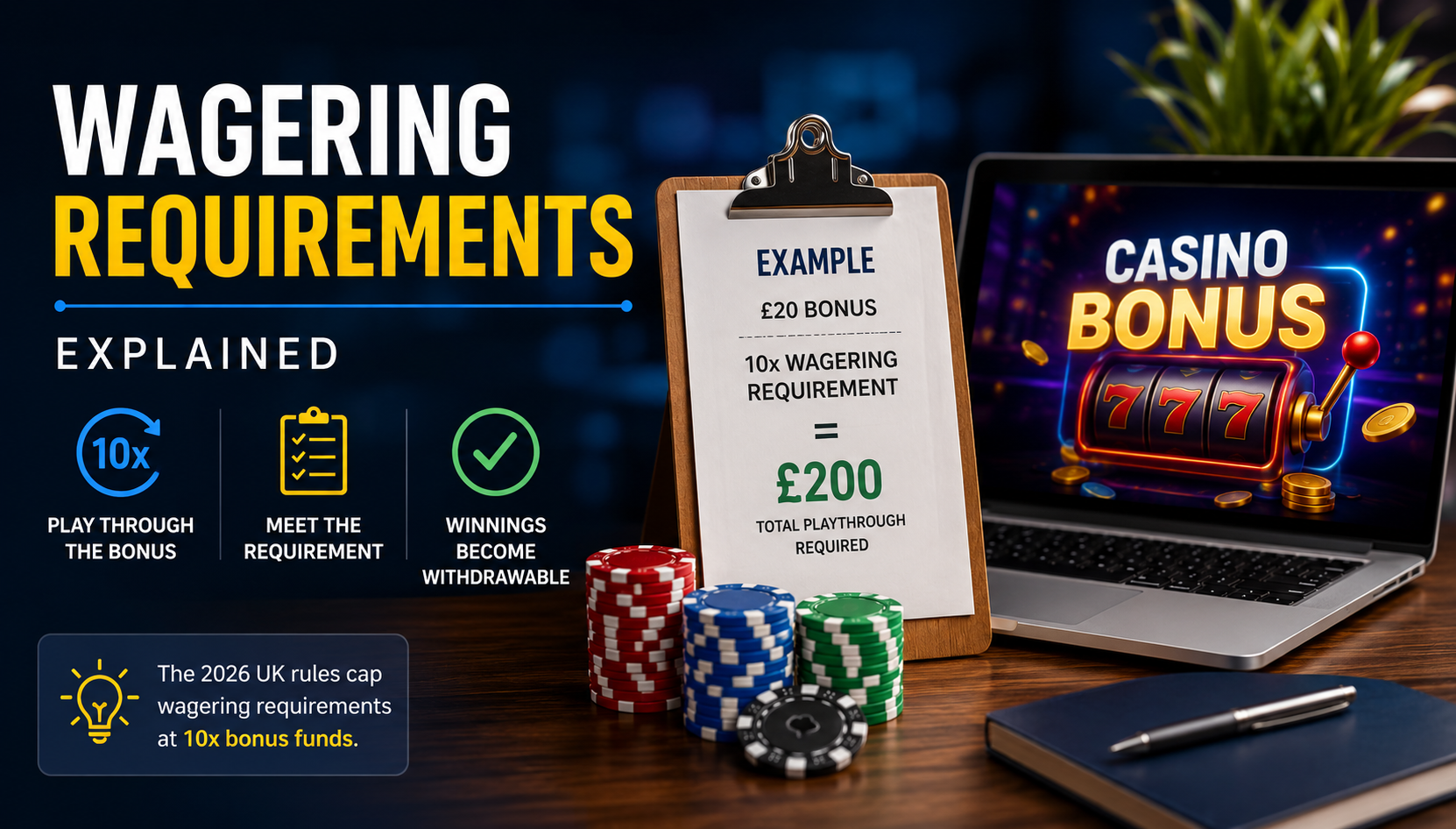
Wagering requirements have always been one of the most confusing parts of casino bonuses.
For years, some offers came with huge playthrough conditions buried deep inside the terms and conditions. A bonus might look generous on the surface, only for players to discover they needed to wager the winnings dozens of times before they could withdraw anything.
In 2026, the UK gambling market changed that.
New Gambling Commission rules introduced a cap on wagering requirements and banned mixed-product promotions designed to push players across multiple forms of gambling. The aim was to make bonuses simpler, clearer and less risky for consumers.
That sounds straightforward enough. In practice, though, wagering requirements still matter, and understanding them properly is still one of the most important parts of comparing casino offers.
In this guide, we’ll explain:
✔️ what wagering requirements actually are
✔️ what changed under the new UK rules
✔️ and what players should still check before claiming a bonus
💡 The Big 2026 Change
UK casinos can no longer apply wagering requirements above 10x bonus funds under the updated Gambling Commission rules.
The changes were introduced to make bonus offers clearer and less harmful for players.
What are wagering requirements?
A wagering requirement is the amount of money that must be played through before bonus winnings can be withdrawn.
In simple terms, it acts as a playthrough condition attached to a casino bonus.
For example, imagine a casino gives you a £10 bonus with a 10x wagering requirement. That means the £10 must be wagered 10 times before any winnings linked to it become withdrawable. In this case, the total playthrough requirement would be £100.
Before the 2026 rule changes, some UK bonuses carried wagering requirements of 35x, 40x or even higher. That meant relatively small bonuses could require hundreds of pounds worth of betting activity before players could cash out.
The Gambling Commission specifically highlighted this issue when announcing the changes, giving the example that a £10 bonus with 50x wagering would require £500 of play before withdrawal.
That is exactly the kind of structure the new rules were designed to reduce.
Why did the UKGC change the rules?
The Gambling Commission said the changes were introduced to make promotions “safer and simpler” for consumers.
According to the regulator, very high wagering requirements could confuse players, encourage longer gambling sessions, and increase the risk of harm. The Commission also raised concerns about mixed-product promotions, where players were encouraged to move between different gambling products, such as sports betting and online slots, within the same offer.
As a result, the updated rules introduced a maximum 10x wagering cap and banned mixed-product bonus offers entirely.
The rules officially came into force on 19 January 2026.
⚖️ Why The Rules Changed
The Gambling Commission said high wagering requirements could make promotions harder to understand and encourage players to gamble for longer than intended.
The updated rules are designed to make casino bonuses clearer, simpler and more transparent for UK players.
What does the 10x wagering cap actually mean?
For players, the biggest change is that bonus offers are no longer allowed to come with extremely high playthrough conditions.
Before the new rules, it was common to see promotions with wagering requirements of 35x, 40x or even 50x attached to bonus funds. On paper, a large welcome offer might have looked impressive, but the amount of play required underneath it could be enormous.
The new 10x cap changes that balance quite a bit.
If a casino gives you a £10 bonus today, the maximum wagering requirement attached to those bonus funds is now £100. Under older-style offers, that same bonus could easily have required £300, £400 or more in total wagering before any winnings could be withdrawn.
That does not suddenly make every bonus amazing, but it does make offers easier to understand and generally less aggressive than they used to be.
There is another important detail here as well.
Other terms to consider
The cap applies to the bonus funds themselves, not necessarily every other condition attached to the promotion. Casinos can still apply:
- expiry periods
- game restrictions
- maximum withdrawal limits
- and eligible game lists
So while the playthrough side is much simpler than before, players still need to check how the offer actually works in practice.
Another thing worth understanding is that different slots can still contribute differently towards bonus playthrough.
Some games may count fully towards wagering requirements, while others contribute less or are excluded entirely. That means a bonus can still feel slower to clear depending on which games you use. That’s one reason why understanding how different slots actually behave matters more than many players realise.
This is one reason why many operators now focus heavily on selected-game promotions tied to specific slots or campaigns.
💡 Simpler Does Not Mean Identical
The 10x cap makes UK bonuses easier to understand, but promotions can still vary quite a bit depending on the games, restrictions and payout conditions attached.
That’s why checking the full bonus terms still matters.
Why bonuses are still not always as simple as they look
The 2026 changes removed a lot of the more extreme wagering structures, but that does not mean every casino bonus is now completely straightforward.
In many cases, the headline offer still only tells part of the story.
A promotion might advertise:
- “100 free spins”
- “£20 casino bonus”
- or “10x wagering”
…but the way the offer actually behaves can still vary depending on the terms underneath it.
Changes with games in the promotions
One of the biggest differences comes from eligible games.
Some bonuses only work on selected slots, while others exclude certain providers or high volatility games entirely. Casinos have shifted towards campaign-led promotions built around specific titles like Big Bass Bonanza, Gates of Olympus or Sweet Bonanza.
This is especially common with modern free spins offers, where promotions are often tied to selected games or provider campaigns.
That means two bonuses with the same wagering requirement can still feel very different once you start using them.
Time limits
There are also time limits to think about.
Some bonuses expire quickly, while bonus winnings may need to be used within a set number of days before they disappear. Casinos can also apply maximum withdrawal limits on bonus winnings, which is another condition players often overlook.
None of this means bonuses are misleading by default. The industry has moved towards clearer offers than it had a few years ago. But it does mean players still need to read the important details rather than focusing only on the headline number.
No mixed product offers
Another change worth noting is the disappearance of mixed-product offers.
For years, many operators encouraged players to move between sports betting, casino games and other gambling products as part of the same promotion. Under the updated rules, those offers are no longer allowed in the UK market.
That is one reason modern bonuses now feel more segmented and slot-specific than they used to.
🎰 What Players Should Really Compare
The size of the bonus matters far less than how the offer actually works once you start using it.
Wagering requirements are now simpler in the UK, but game restrictions, expiry periods and withdrawal limits still shape the overall value of a promotion.
Are wagering requirements better now than they used to be?
For most UK players, they probably are.
A few years ago, casino bonuses often relied on huge headline offers paired with very high wagering requirements hidden deeper in the terms. A promotion might have looked generous at first glance, but actually required hundreds of pounds’ worth of play before any winnings could be withdrawn.
The wagering requirement rule changes have reduced a lot of that complexity. Clearer bonus structures also make it easier for players to understand what’s actually happening during play.
By introducing a 10x cap and banning mixed-product promotions, the Gambling Commission has pushed operators towards offers that are simpler and easier to compare. The most extreme wagering structures that used to dominate parts of the market have largely disappeared from regulated UK casinos.
That does not mean every bonus is suddenly brilliant value, though.
Casinos still structure promotions differently, and smaller details can still change how useful an offer feels once you start using it. Eligible games, expiry periods and withdrawal restrictions still matter, especially now that many promotions are built around selected slots or provider campaigns rather than broad “play anywhere” bonuses.
The difference is that the core playthrough requirement is now much easier to understand than it used to be.
For players, that probably makes modern UK bonuses feel less aggressive overall. The huge “too good to be true” offers have mostly faded away, replaced by smaller promotions with cleaner terms attached. Some players will prefer that change. Others may miss the larger bonuses that used to dominate casino marketing.
Either way, the direction of travel is fairly clear. UK bonuses are becoming more controlled, more transparent and more focused on simplicity than they were a few years ago.
✔️ Simple Takeaway
Modern UK wagering requirements are far lower and easier to understand than the older bonus structures many players were used to.
The terms still matter, but the overall system is much clearer than it was before the 2026 changes.
Wagering Requirements FAQs
What is a wagering requirement?
A wagering requirement is the amount of money that must be played through before bonus winnings can be withdrawn. It acts as a playthrough condition attached to a casino bonus.
What does 10x wagering mean?
If a bonus has 10x wagering, the bonus amount must be played through ten times before winnings become withdrawable. For example, a £10 bonus with 10x wagering would require £100 worth of play.
Did the UK change wagering requirement rules in 2026?
Yes. The Gambling Commission introduced a maximum 10x wagering cap and banned mixed-product bonus offers in January 2026 to make promotions simpler and safer for players.
Are wagering requirements lower now than they used to be?
Generally, yes. Older UK bonuses often carried wagering requirements of 35x, 40x or higher. The current rules limit operators to a maximum of 10x bonus funds.
Do wagering requirements still matter after the new rules?
Absolutely. Even with the 10x cap, players should still check eligible games, expiry periods, withdrawal limits and how winnings are handled before claiming a bonus.