








UK Gambling Affordability Checks Spark Backlash Among Horse Racing Bettors
Published on by Zena Grantham
New developments surrounding UK gambling affordability checks have reignited debate across the betting industry, with a particular focus on the potential impact on horse racing.
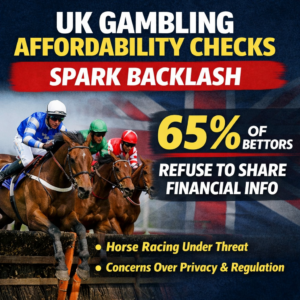
Fresh proposals and ongoing pilot schemes, combined with newly released polling data, have intensified concerns that the measures could alienate a large section of UK bettors. A recent survey commissioned by the Betting and Gaming Council (BGC) found that more than 65% of bettors would refuse to provide financial documents if requested by operators.
The findings add weight to growing industry fears that affordability checks, in their current form, risk pushing customers away from regulated betting environments.
Focus on Horse Racing as Affordability Checks are Expanded
While affordability checks have been on the table since the 2023 Gambling White Paper, the focus has shifted to include horse racing bettors.
Horse racing remains one of the UK’s most popular betting sports, with a significant portion of its funding tied to wagering activity. As a result, any regulatory change that affects betting behaviour has immediate implications for the sport’s financial stability.
Recent proposals and pilot schemes have focused on how affordability checks will apply to horse racing punters, especially those who place regular bets but do not fall into “high-risk” categories.
Industry stakeholders argue that racing punters, many of whom place frequent, moderate wagers, are disproportionately exposed to the proposed thresholds.
Poll Reveals Strong Resistance from Punters
The BGC-commissioned poll has become a focal point in the debate.
According to its findings, over 65% of UK bettors said they would not be willing to share personal financial information with gambling operators. This includes payslips, bank statements, or proof of income.
The data suggests a disconnect between regulatory expectations and customer sentiment.
For many bettors, the issue is not just about inconvenience, but principle. Gambling has traditionally been treated as a discretionary activity, and the idea of financial scrutiny, particularly at relatively modest spending levels, has raised concerns of overreach.
The poll also highlights the risk that customers will disengage from regulated platforms if faced with intrusive verification processes.
Proposed Thresholds Under Scrutiny
At the centre of the controversy are the proposed financial thresholds that trigger affordability checks.
Current pilot schemes indicate that light-touch financial risk checks may be triggered at a low threshold of £150 per month.
More detailed checks are expected at higher loss levels. These would include £1,000 within a 24-hour period or £2,000 over 90 days.
Critics argue that these thresholds are too low and could capture a wide range of casual or recreational bettors, particularly those engaged in regular horse racing betting.
This has led to concerns that punters who do not exhibit harmful behaviour may still be subjected to financial assessments.
Privacy and Data Concerns Intensify
Privacy remains a central issue in the debate.
Although regulators have emphasised that many checks will be conducted using existing data sources, enhanced checks may require direct input from customers. This could include sensitive financial information that many bettors are unwilling to share.
The BGC poll reinforces this concern, suggesting that most bettors are uncomfortable with the level of access operators may require.
There are also broader questions around data handling, including how information is stored, who has access to it, and how it may be used across different platforms.
For many, the issue is not simply about compliance, but about trust.
Horse Racing Industry Warns of Financial Impact
The potential consequences for horse racing have been widely discussed within the industry.
Racing bodies have warned that affordability checks could lead to a decline in betting turnover. Any decline would directly affect funding from the Horserace Betting Levy.
Industry estimates indicate that a decline in betting activity could lead to substantial financial losses for the sport. Moreover, prize money, operational capacity, and the sport’s long-term viability would be directly impacted.
There are also concerns that racing’s core audience, including regular bettors who engage with the sport weekly, may be among those most affected by the proposed affordability checks.
If customer activity decreases or they move away from regulated operators, the knock-on effects could be substantial.
Risk of Shift Toward Unregulated Markets
Another key concern is the potential migration of bettors to unlicensed or offshore platforms.
Operators and industry bodies have warned that increased friction within the regulated market may encourage users to seek alternatives where affordability checks are not enforced.
Black market platforms operate outside of the UK jurisdiction and do not provide the same level of consumer protection.
The concern is that stricter regulation, while intended to reduce harm, could unintentionally expose punters to greater risk. The greatest risk would be punters migrating into unregulated markets.
Regulators Defend the Approach
Despite criticism, regulators maintain that affordability checks are a necessary step in modernising gambling oversight.
The Gambling Commission has stated that most checks will be carried out smoothly. The Commission will use existing data without customer interaction.
The aim is to identify financial vulnerability early, rather than reacting after harm has already occurred.
Officials have emphasised that pilot schemes are being used to refine the system. Adjustments are expected based on real-world data and feedback.
However, the extent to which these assurances will address industry and consumer concerns remains unclear.
A Critical Moment for UK Betting Policy
The latest developments mark a critical stage in the rollout of UK gambling affordability checks.
However, there is strong resistance from bettors and increasing concern within the horse racing industry. With ongoing uncertainty about implementation, the issue remains far from being resolved.
The coming months will be shaped by the outcomes of pilot programmes and continued dialogue between regulators, operators, and stakeholders.
What is clear is that the balance between consumer protection and personal freedom will remain at the centre of this debate.