









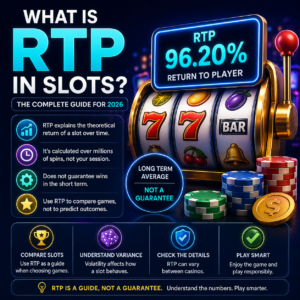
RTP, or Return to Player, is the share of all the money staked on a slot that the game is designed to pay back over the very long run. A slot with a 96% RTP returns £96 for every £100 staked across hundreds of thousands of spins – on average, over time. The remaining 4% is the house edge, the built-in margin the casino keeps.
The single most important thing to understand is this: RTP is a long-run theoretical average, not your chance of winning today. This guide explains what RTP really means, how it is calculated, what counts as a good figure, why the same slot can carry different RTPs, and how to check the value for the game in front of you – including figures we have verified in-game ourselves.
RTP at a glance
How RTP actually works
Every regulated online slot runs on a certified Random Number Generator (RNG). The RNG produces a constant stream of random numbers, and the number generated the instant you press spin decides the result. Each spin is independent: the game has no memory of what came before, so a slot is never “due” a win and a losing streak does not make the next spin any more likely to pay.
RTP is a mathematical property baked into that design. Add up everything a game pays out, divide by everything staked, across a huge number of spins, and you get the RTP. Because it is measured over such a vast sample, your own session can land far above or far below it. Over a few hundred spins almost anything can happen; RTP only describes the long-run tendency.
How is RTP calculated?
RTP is simply total returns divided by total stakes, expressed as a percentage:
RTP = (total paid out ÷ total staked) × 100
The catch is the sample size. Providers model and test a game over millions of simulated spins, because short runs are wildly unreliable. Over 50,000 spins the measured return can sit several percentage points away from the true figure; only across hundreds of thousands or millions of spins does it settle down to the stated RTP. That is exactly why your afternoon on a slot tells you nothing about its RTP – you are nowhere near the sample size the number is based on.
RTP and the house edge
RTP and house edge are two sides of the same coin. The house edge is simply 100% minus the RTP. A 96% RTP means a 4% house edge: over the long run the game keeps around £4 of every £100 staked. A lower RTP means a bigger house edge and worse long-term value for you. Slot RTPs generally range from about 92% to 98%, so the house edge on slots typically runs between 2% and 8%.
What is a good RTP for slots?
Most UK online slots sit between 94% and 96.5%. As a rule of thumb, the higher the RTP, the more of your stake comes back over time – but remember this is about long-run value, not your odds in a single session.
| RTP | Long-run player value | What it means |
|---|---|---|
| 97% and above | Excellent | Among the most player-friendly slots – the game keeps under £3 of every £100 staked, on average over time. |
| 96-97% | Good | Around or above the typical UK average. |
| 94-96% | Below average | The house keeps more of your stake over time. |
| Under 94% | Poor value | Keeps significantly more – worth knowing before you play. |
RTP vs volatility: how much vs how often
RTP is only half the story, and volatility (sometimes called variance) is the other half. RTP tells you how much a game returns over time; volatility tells you how often and how big those returns arrive.
- Low volatility slots pay small amounts frequently. Your balance drifts down slowly, with regular small wins – steadier, but rarely a big hit.
- High volatility slots pay rarely but larger. Long dry spells are punctuated by occasional big wins, so the swings are far more extreme.
Two slots can share an identical 96% RTP and feel completely different to play. If your budget is small, high volatility can empty it before the big win ever lands; if you are chasing a large payout, low volatility may feel flat. Always read RTP and volatility together.
RTP is not your chance of winning
This is where many players are misled. A 97% RTP slot does not give you a 97% chance of winning. You can play a high-RTP slot and lose your whole stake, and no game is ever “due” a payout. RTP describes how much a game returns across an enormous number of spins – it says nothing about whether you personally will be up or down when you stop. Slots are games of chance, and outcomes cannot be predicted or guaranteed.
A worked example
Say you play 500 spins at £0.50 on a 96% RTP slot. You stake £250 in total, the theoretical return is £240, and on average the game keeps £10. But “on average” hides enormous swings: across those 500 spins you might finish £80 down, or trigger a feature and walk away £150 up. RTP is the centre of a very wide range of possible outcomes, not a figure your session steadily moves toward. You can model any RTP, stake and spin count with our RTP calculator.
The same slot can have a different RTP
Studios often release a game in several RTP versions – for example 96%, 94% and 92% builds of the same slot – and the casino chooses which one to integrate. That means a slot listed at 96% on one site can run at 94% on another. This is why you should always check the RTP shown in the game at the specific casino you are playing, not just a figure quoted elsewhere.
Jackpot slots add another layer. Part of the headline RTP funds the base game, and part is siphoned off to build the progressive jackpot. Here is a real example from a game we checked ourselves, reading the figures straight from the in-game rules screen rather than a third-party database – Genie Jackpots (version 1.6.0.5):
| Genie Jackpots (v1.6.0.5) | RTP |
|---|---|
| Base game | 92.73% |
| Progressive jackpot contribution | 0.38% |
| Jackpot reserve | 0.11% |
| Combined theoretical RTP | 93.11% |
So the base game returns 92.73%, another 0.38% feeds the progressive jackpot and 0.11% is held in reserve, for a combined theoretical RTP of 93.11%. Because these values can differ by version and by casino, you may see other figures published elsewhere – these are what the game we tested actually displayed.
How to check a slot’s RTP
How to find a slot's RTP
- 1Open the game and load its menu, settings or information (i) button
- 2Find the rules, paytable or game information screen
- 3Look for RTP or Return to Player, usually near the bottom
- 4Note the version number if one is shown, as RTP can vary by build
- 5Compare it against the figure the casino or provider publishes
Does RTP change between casinos?
The RTP of a specific version of a game does not change from spin to spin, and a licensed casino cannot secretly alter a certified game’s RTP. What can differ is which version a casino has integrated, as explained above. Reputable UK-licensed casinos publish the RTP of the build they run.
Who tests and certifies RTP?
You do not have to take an operator’s word for it. Independent testing houses audit slots and their random number generators, verifying that the real-world return matches the stated RTP. The main names you will see are:
- eCOGRA – a long-established testing agency that certifies game fairness and publishes RTP audits.
- iTech Labs and GLI (Gaming Laboratories International) – accredited labs that test RNGs and RTP against regulatory standards.
In Britain, any game offered by a UK Gambling Commission-licensed casino must be independently tested to the Commission’s technical standards before it goes live, and the RNG must be demonstrably fair. That testing is what turns a stated RTP from a marketing number into a verified one.
Examples of high-RTP slots
To show the range, here are some of the higher-RTP slots in our database. Remember these are the provider’s headline figures – always check the version running at your casino, as it may differ.
| Slot | Headline RTP |
|---|---|
| Don Deal | 99.28% |
| Mega Joker | 99.00% |
| Dice Shooter | 99.00% |
| Classic Cinema | 98.47% |
| Tiki Reward | 98.32% |
| Marching Legions | 98.12% |
Browse many more in our online slots directory, where you can filter by RTP, or see our roundup of NetEnt slots with the best RTP.
RTP, bonuses and wagering
If you play with a bonus, RTP interacts with the game weighting in the bonus terms. Slots usually contribute 100% toward wagering requirements, but some contribute less and a few are excluded entirely. A high RTP does not help much if a game barely counts toward clearing a bonus, so always read the terms before you opt in.
RTP beyond slots
RTP applies right across the casino, and some games return far more than slots. The principle is always the same: it is a long-run theoretical return, not a promise about your session.
| Game | Typical RTP | House edge |
|---|---|---|
| Blackjack (basic strategy) | up to ~99.5% | ~0.5% |
| Video poker (full-pay) | up to ~99.5% | ~0.5% |
| French roulette (la partage) | ~98.65% | 1.35% |
| European roulette | ~97.30% | 2.70% |
| Online slots | 92-98% | 2-8% |
| American roulette | ~94.74% | 5.26% |
| UK National Lottery | ~50% | ~50% |
High RTP is not everything
RTP is one useful signal, not the whole story. Volatility, your budget, the theme and features, and whether you are playing for entertainment or chasing a jackpot all matter too. Treat RTP as a way to compare long-term value between games – then set a budget you are comfortable losing and stick to it.
Try it yourself
Use our calculator to see the theoretical return and average cost to play for any RTP and stake:
RTP calculator
Enter a game's RTP and how you play to see the theoretical, long-run return and what the game keeps on average. These are not a prediction of any single session.
18+ - Slots are games of chance; outcomes can't be predicted or guaranteed. Please gamble responsibly - GambleAware.org
What does RTP mean in slots?
RTP stands for Return to Player. It is the percentage of all money staked that a slot is designed to pay back over the long run. For example, a 96% RTP slot returns about 96 pounds for every 100 pounds staked, on average across a huge number of spins.
What is a good RTP for slots?
Most UK slots sit between 94% and 96.5%. Anything 96% or above is around or better than average, and 97% or higher is among the most player-friendly. Remember this is about long-run value, not your chance of winning.
Does a higher RTP mean I will win more often?
No. A higher RTP returns more of the total staked over the long run, but it does not change your chance of winning any single session. How often a game pays is its volatility, not its RTP.
Is 94% RTP good?
94% is on the lower side for a modern online slot, giving the house a 6% edge. It is playable but below the typical UK average of around 95-96%, so over time it returns less of your stake than a higher-RTP game.
Can a casino change a slot’s RTP?
A licensed casino cannot secretly alter a certified game’s RTP. However, many slots ship in several RTP versions and the casino chooses which one to offer, so the same slot can run at different RTPs on different sites. Always check the version integrated where you play.
How do I check the RTP of a slot?
Open the game’s information, rules or paytable screen, where the RTP is usually listed, sometimes with a version number. You can also check the figure the casino or provider publishes.
What is the house edge?
The house edge is 100% minus the RTP. A 96% RTP slot has a 4% house edge, meaning the game keeps about 4 pounds of every 100 pounds staked on average over the long run.
How many spins is RTP based on?
RTP is a theoretical average calculated over an extremely large number of spins, often millions, far more than anyone plays in a session, which is why short-term results vary so much.
Who tests slot RTP?
Independent laboratories such as eCOGRA, iTech Labs and GLI audit slots and their random number generators to confirm the real return matches the stated RTP. Games at UK Gambling Commission-licensed casinos must be independently tested.
What is the highest RTP slot?
Some classic and specialist slots reach 99% or higher, such as Mega Joker. RTP can vary by version and casino, so check the figure shown in the specific game you are playing.
18+ – Gambling is a game of chance and outcomes cannot be predicted or guaranteed. Please gamble responsibly. For free, confidential support visit GambleAware.org.