








If you’ve ever spun a slot and thought, “that felt like a win”… only to realise your balance went down, you’re not imagining things.
It’s a common experience. The reels land, the game celebrates, maybe there’s a bit of music or animation, and for a moment it looks like you’ve come out ahead. Then you check your balance, and it tells a different story.
This is where a lot of confusion around slots starts.
Players often question whether games are fair, whether RTP actually means anything, or whether something has quietly changed behind the scenes. In reality, most of the time, what’s happening is less dramatic and a bit more psychological.
Certain slot mechanics are designed to keep the game engaging, even when the outcome isn’t technically a win. These are often referred to in player discussions online as “ghost wins”.
In this guide, we’ll break down:
➡️ what ghost wins actually are
➡️ how they relate to RTP
➡️ why slots can feel misleading even when they’re working exactly as designed
We’ll also look at how this ties into things like volatility and losses disguised as wins, so you can better understand what you’re actually seeing when you play.
🎰 Why This Matters for Players
Slots don’t just rely on maths. They also rely on how the experience feels while you play. That includes sounds, visuals, and how often the game appears to reward you.
Understanding this doesn’t mean games are unfair. It simply helps you separate what looks like a win from what actually increases your balance.
What is a ‘ghost win’ in slots?
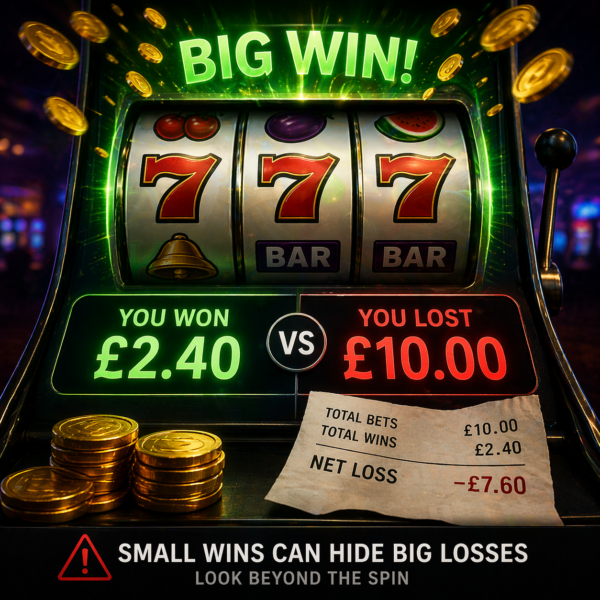
A “ghost win” is when a slot shows a winning combination, but the payout is less than your original stake.
So technically, the game registers it as a win. In reality, your balance still goes down.
For example:
You spin £1
The reels land a small combination
The game pays out £0.40
The slot celebrates like you’ve won
But you’ve still lost £0.60 overall.
That’s what players often refer to as a ghost win.
You’ll see this more often on:
slots with lots of paylines
games with cluster pays or cascading mechanics
lower volatility slots that aim to pay out frequently
The key thing to understand is that these outcomes are not errors or glitches. They’re part of how the game is designed.
Slots are built to produce frequent small returns as well as occasional larger wins. That mix helps create a steady flow of results rather than long stretches of nothing happening.
Where it gets confusing is the presentation.
Even a small return can trigger:
⭐ animations
⭐ sound effects
⭐ visual highlights
All of which can make it feel like a proper win, even when it isn’t.
⚖️ Important: Not All “Wins” Are Equal
Slots count any return as a win, even if it’s smaller than your stake. That’s why your win count can look high while your balance is still going down.
This doesn’t mean the game is unfair. It just means “win” in slot terms doesn’t always mean profit.
Why do slots show wins that aren’t actually profitable?
At first glance, it can feel a bit odd.
If a result leaves you with less money than you started with, why present it like a win at all?
The short answer is that slots are designed around continuous engagement, not just big payouts.
Instead of long stretches of nothing followed by a rare win, most modern slots aim to deliver:
✔️ frequent small returns
✔️ occasional bonus features
✔️and the chance of larger wins over time
That mix creates a more active experience, where something is happening regularly on the reels.
Ghost wins sit right in the middle of that.
They’re part of a wider structure where:
➡️ some spins return nothing
➡️ some return less than your stake
➡️ some return more than your stake
All of those outcomes feed into the game’s overall Return to Player (RTP).
If you’ve read our guide on what RTP is in slots, you’ll know it represents the average percentage a game pays back over a very large number of spins. That calculation includes every type of outcome, including these smaller returns.
So while a £0.40 return on a £1 spin feels like a loss, it still contributes to the long-term payout percentage the game is built around.
💡 Quick Takeaway
Slots aren’t trying to trick you, but they are designed to feel engaging. That means even small returns can be presented in a way that looks like a win.
The important thing is to focus on your balance, not just what the game shows on screen.
Where things get more interesting is how these outcomes are presented.
Slots don’t just show results, they frame them.
A small return might come with:
⭐ celebratory sounds
⭐ flashing symbols
⭐ win counters ticking up
Even when the payout is lower than your stake.
This is where the idea of losses disguised as wins (LDWs) comes in.
It’s closely related to ghost wins, but slightly more specific. It refers to situations where the game actively presents a losing outcome as a win through visuals and feedback.
We’ll break that down properly in our dedicated guide on LDWs, but the key takeaway here is simple:
The way a result looks and feels doesn’t always match what’s actually happening to your balance.
How do ghost slot wins affect how slots feel to play?
Ghost wins can change the way a slot feels, even when the maths behind it hasn’t changed.
That’s a big reason why some players say a game feels tighter, less rewarding, or just a bit off, even if the listed RTP is still exactly the same.
Why? Because players do not experience slots as long-term averages. They experience them spin by spin.
And in that moment, a game that regularly gives back small amounts can create a strange mix of signals:
➡️ you see “wins” appearing often
➡️ the game feels active and responsive
➡️ but your balance may still be drifting down
That gap between what the game shows and what your balance is doing is where a lot of frustration comes from.
It also helps explain why RTP can feel misleading in practice.
A slot might have a decent RTP on paper, but if much of that return is made up of small, frequent payouts that do not meaningfully offset your stake, the experience can still feel underwhelming. You are technically getting money back. It just may not feel like you are getting ahead.
This is also where volatility matters.
Two slots can have a similar RTP, but feel completely different to play:
➡️ one may pay small amounts regularly
➡️ another may go quiet for longer, then pay bigger amounts less often
That is why RTP on its own never tells the full story. It tells you the long-term average, not how rewarding, frustrating, or misleading a game may feel in a short session.
This is one reason the RTP conversation has become more prominent recently. Players are not only asking what the percentage says. They are asking whether the game experience actually matches what they think that percentage should feel like.
⚖️ RTP vs Experience
A slot can be mathematically fair within its design and still feel disappointing to play. That is often because players notice the pattern of results, not the long-term average behind them.
In other words, RTP tells you how a game is built over time. It does not tell you how satisfying each session will feel.
Does this mean slot RTP is misleading too?
Not exactly. But it can be misunderstood.
RTP, or Return to Player, is a real and regulated figure. It represents the average percentage a slot is designed to return over a very large number of spins.
So in that sense, it is not misleading. It is doing exactly what it says on the tin.
The issue is how it’s interpreted.
Most players don’t experience thousands or millions of spins. They experience short sessions. And in those sessions, results can vary a lot.
That means:
➡️ you can play a high RTP slot and still lose quickly
➡️ you can play a lower RTP slot and hit a decent win early
➡️ you can see lots of “wins” but still end up down overall
This is where ghost wins and small payouts come back into the picture.
If a large portion of a slot’s RTP is made up of:
small, frequent returns
partial payouts below your stake
Then technically, the game is returning money as expected. But it may not feel like it is.
So the disconnect is not that RTP is wrong. It is that RTP describes long-term behaviour, while players judge the game based on short-term experience.
✔️ Key Point
RTP is not there to predict what will happen in your session. It is there to describe how a slot behaves over time.
Understanding that difference makes it much easier to interpret what you’re actually seeing when you play.
It’s also worth noting that RTP does not exist on its own.
How a slot feels is shaped by a mix of factors:
➡️ volatility
➡️ hit frequency
➡️ bonus features
➡️ and how wins are presented
RTP sits on top of all that as a single average number. Useful, but limited.
That’s why two games with similar RTP can feel completely different to play, and why focusing on RTP alone can sometimes lead to the wrong expectations.
What should players focus on instead?
If RTP on its own doesn’t tell the full story, what should you actually pay attention to?
The biggest shift is moving your focus away from what the game is showing you and onto what’s actually happening to your balance.
It’s easy to get drawn into how a slot feels. Frequent “wins”, animations, and sound effects can make it seem like things are going well, even when your balance is quietly dropping in the background.
A better approach is to keep things simple. Look at how much you’re staking, how long your balance is lasting, and whether the returns you’re getting are actually covering your spins. That tells you far more than the win counter ever will.
It also helps to understand a couple of key concepts alongside RTP.
Volatility is a big one. Some slots are designed to pay small amounts regularly, which can make them feel steady but not especially rewarding. Others go quiet for longer and then hit bigger wins, which can feel more dramatic but also more unpredictable.
Then there’s hit frequency, which is simply how often the game returns anything at all. A slot can feel busy and active if it’s paying something often, even if those amounts are small.
When you put these pieces together, it becomes clearer why two games with similar RTP can feel completely different to play.
✔️ Practical Takeaway
Don’t judge a slot by how often it celebrates. Judge it by what happens to your balance over time.
Once you separate presentation from actual returns, the game becomes much easier to understand.
Finally, it’s worth keeping expectations realistic.
Slots are built around long-term averages and random outcomes. There isn’t a reliable way to predict how a short session will go, and there isn’t a pattern you can follow to “beat” the game.
Understanding things like ghost wins and RTP won’t change the results, but it will help you make sense of what you’re seeing while you play. And that usually makes the experience feel a lot less confusing.
Ghost Wins and Slot RTP FAQs
What is a ghost win in slots?
A ghost win is when a slot pays out less than your original stake but still presents the result as a win. Your balance goes down overall, even though the game celebrates the outcome.
Are slot wins designed to be misleading?
Not exactly. Slots are designed to be engaging, which means even small returns can be presented with sounds and animations. This can make results feel more positive than they actually are, but it does not mean the game is unfair.
Do ghost wins affect RTP?
Yes, they are included in RTP calculations. RTP reflects all outcomes over time, including small payouts that are lower than your stake, as well as larger wins.
Why do I feel like I’m winning but losing money?
This usually comes down to frequent small returns. The game may show lots of wins, but if those payouts are smaller than your stake, your balance will still decrease over time.
Does a higher RTP mean fewer ghost wins?
Not necessarily. A higher RTP means the game returns more over the long run, but it does not control how those returns are distributed. A slot could still include plenty of small payouts as part of its overall design.